
One Customer, Many Silos: How Enterprise Workflow Orchestration Unifies Every Insurance Line

A customer might file a motor claim on Monday, renew a health policy on Tuesday, and inquire about a life policy on Wednesday. To the customer, it's one insurer. Internally, however, many insurers still rely on separate systems, teams, and processes for each product line. That fragmentation often leads to delays, duplicate work, inconsistent data, and disconnected customer experiences.
Enterprise workflow automation solves this problem by connecting every line of business through a shared execution layer. Instead of operating as disconnected departments, Life, Health, and Motor teams work from the same foundation, using consistent workflows, shared data, and standardized governance. The result is faster operations, better compliance, and a seamless customer experience.
Insurance workflow automation: One foundation for every policy
Insurance workflow automation replaces repetitive, rule-based tasks with automated processes across the insurance lifecycle. Activities such as document verification, policy issuance, claims routing, eligibility checks, and payment approvals follow consistent workflows instead of relying on manual handoffs.
Although insurance products are different, many of the processes behind them are the same. Policies are issued, premiums are collected, claims are assessed, and payouts are made. Instead of creating separate workflows for each product line, insurers can build one set of workflows and adapt them where needed.
The same automation principles can be adapted to different insurance products, as shown in the following two examples:
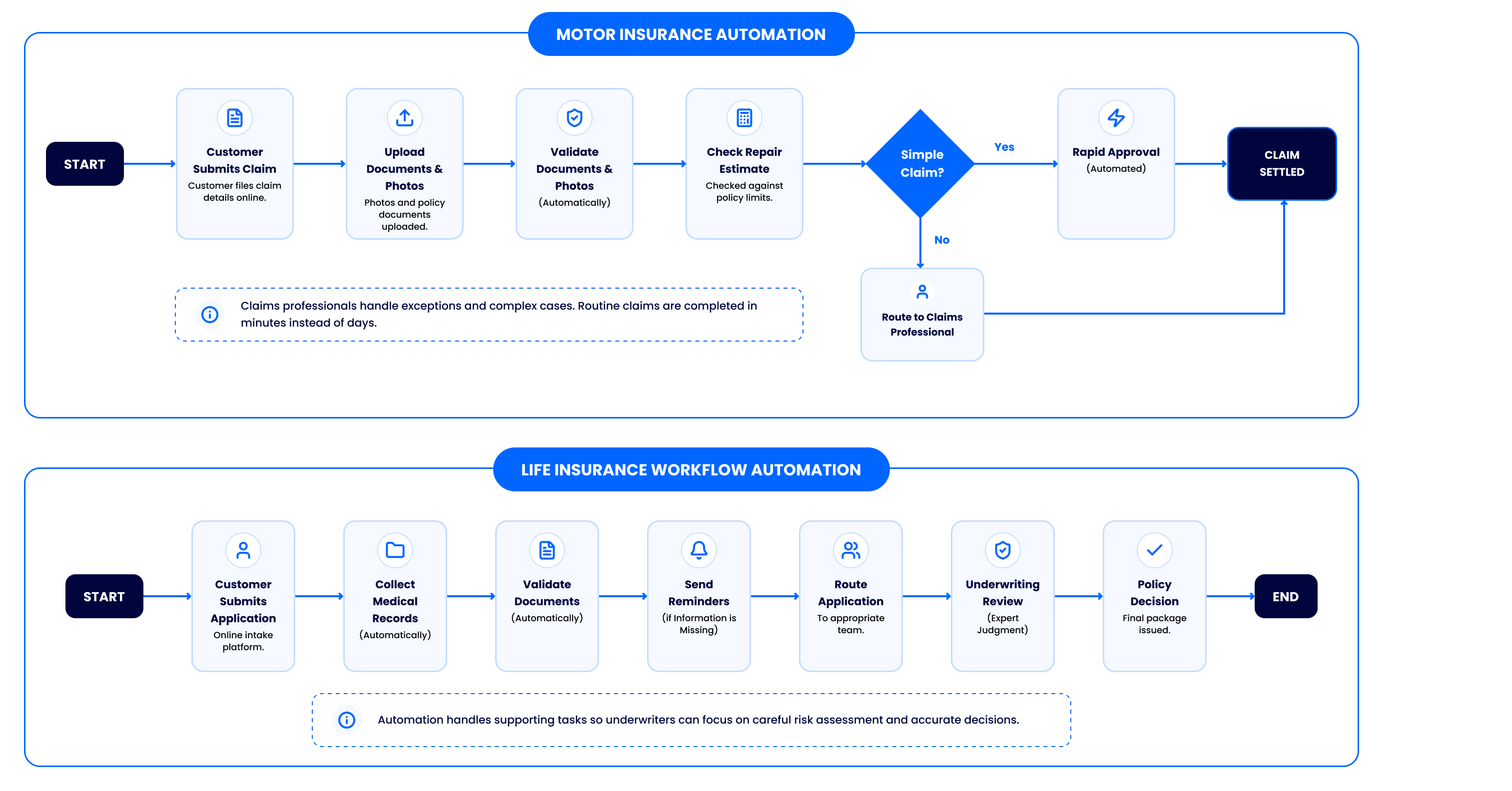
Business process orchestration: Connecting every workflow
Automating individual tasks is only part of the transformation. Business process orchestration connects those automated tasks into one coordinated system that spans departments and product lines.
Instead of isolated workflows, orchestration creates a common execution layer where work flows seamlessly between underwriting, claims, customer service, finance, and compliance. Information follows the customer rather than remaining trapped inside departmental systems.
While automation and orchestration are closely related, they serve different purposes. The table below highlights the key differences:
Insurance Orchestration vs. Automation
| Automation | Insurance Workflow Orchestration |
| Automates individual tasks or activities | Connects multiple tasks into one end-to-end workflow |
| Focuses on making a specific task faster and more efficient | Focuses on managing the entire customer or business process |
| Follows predefined rules to complete a task | Coordinates what happens next, who should act, and how information moves between teams and systems |
| Example: Automatically approving a low-value motor claim | Example: Updating customer records, checking related policies, notifying relevant teams, and triggering renewal opportunities after the claim is approved |
AI orchestration platform: Adding intelligence to automation
Once insurers establish a shared execution layer, they can enhance it with an AI orchestration platform. Instead of following only predefined rules, AI evaluates each case and routes work according to complexity, risk, and business priorities.
Simple claims may move directly to payment, while unusual or high-risk cases are escalated to experienced adjusters. This allows insurers to allocate resources more effectively while maintaining consistent customer service.
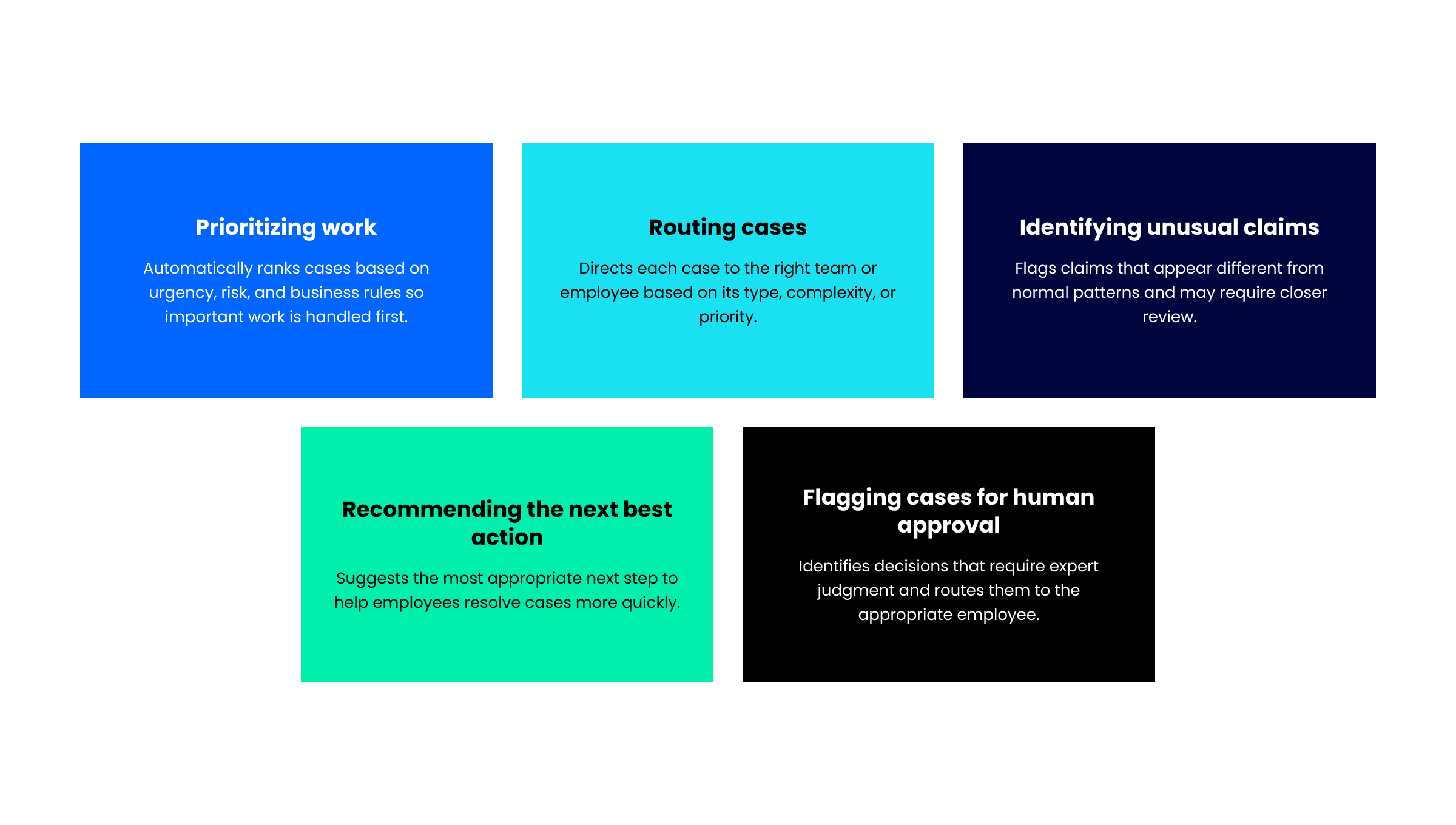
Together, these capabilities help insurers respond more quickly, reduce delays, and keep work moving efficiently across teams while maintaining consistency throughout the customer journey.
Importantly, AI workflow orchestration supports decision-making rather than replacing human expertise. Employees continue making judgment-based decisions while AI handles repetitive analysis, prioritization, and workflow coordination.
Enterprise AI governance: Scaling responsibly
Automation and AI only create value when supported by strong enterprise AI governance.
Insurance organizations manage highly sensitive financial and personal information. Automated systems must therefore operate within clear governance frameworks that define which decisions AI can make independently, which require human approval, and how every decision can be explained during audits or regulatory reviews.
Strong governance also includes data security, bias monitoring, model validation, and continuous performance reviews. These safeguards allow insurers to expand automation confidently without increasing regulatory or operational risk.
Rather than slowing innovation, enterprise AI governance enables organizations to scale AI responsibly across the enterprise.
Insurance digital platform: The foundation for enterprise operations
When automation, orchestration, and governance work together, insurers create a modern insurance digital platform.
Unlike disconnected legacy systems, an insurance digital platform provides shared customer records, standardized workflows, centralized reporting, and consistent business rules across every line of business. Individual products retain their unique requirements while operating on a common operational foundation.
Customers benefit from a unified experience. Someone holding both Motor and Health policies appears as one customer instead of multiple disconnected records. A change in one policy can automatically trigger relevant updates elsewhere, improving service while reducing manual coordination.
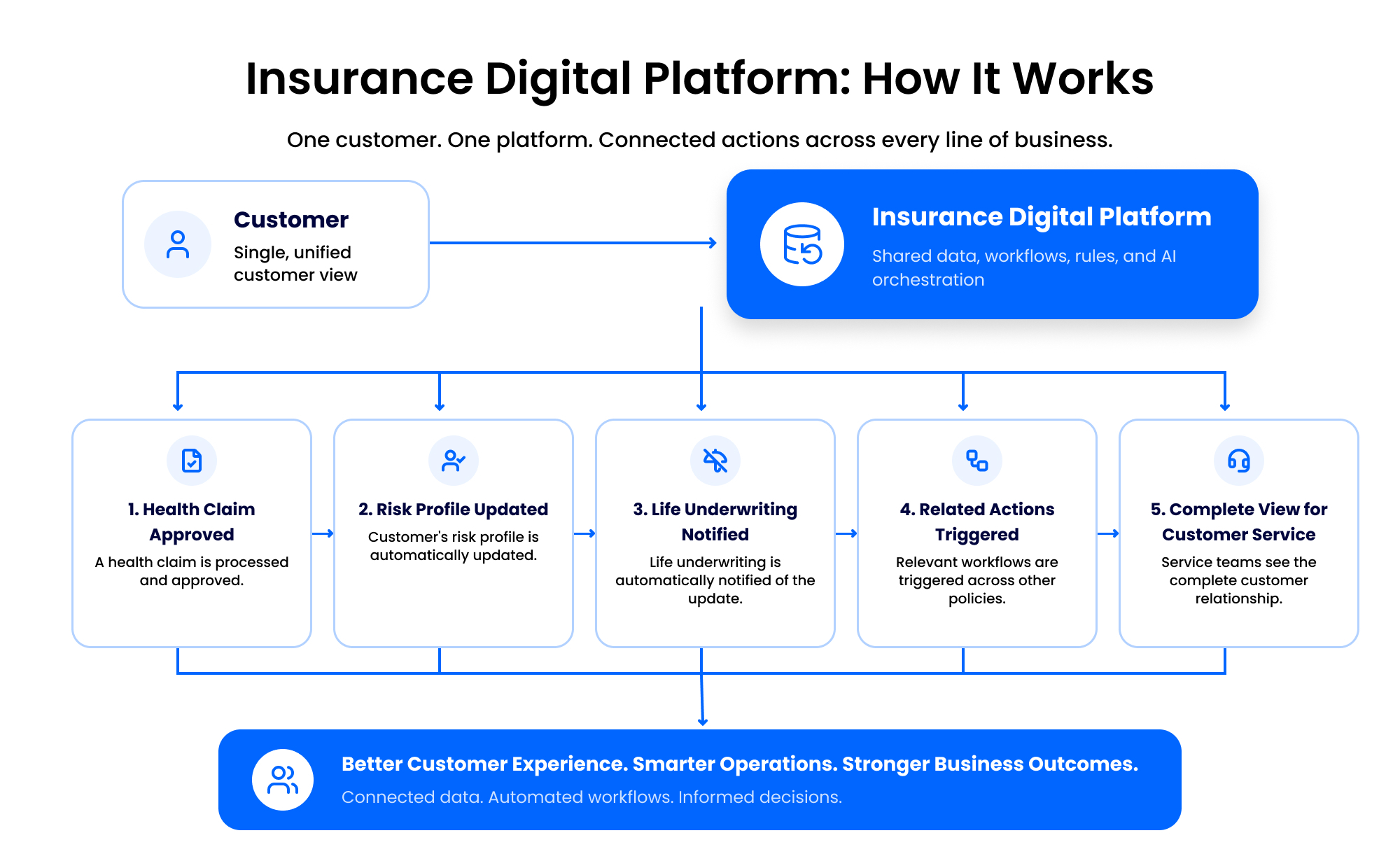
For example, a health claim that changes a customer's risk profile can automatically notify Life underwriting. A motor policy cancellation may trigger retention workflows for other active policies. Customer service teams gain visibility into the complete relationship instead of working with isolated records.
Because workflows are orchestrated centrally, these connections happen automatically rather than depending on employees to remember each step.
Powering the connected insurance enterprise
Insurance has always been built on trust. Customers expect insurers to respond quickly, consistently, and accurately whenever they need support.
Neutrinos provides the enterprise platform that brings insurance workflow automation, business process orchestration, AI-driven decision-making, and enterprise AI governance together in a single solution. By connecting people, systems, data, and AI across the insurance value chain, Neutrinos replaces fragmented operations with intelligent, end-to-end workflows.
The result is a modern insurance digital platform where Life, Health, Motor, and other lines of business operate as one connected enterprise rather than separate silos. Customers receive faster, more consistent service, employees spend less time on repetitive administrative work, and insurers gain the agility to innovate while maintaining compliance, transparency, and operational control.
Ready to modernize your insurance operations? Discover how Neutrinos helps insurers unify workflows, orchestrate AI, and accelerate digital transformation across every line of business. Book a demo now.
Frequently asked questions
Insurance workflow automation uses technology to handle routine tasks like processing claims, issuing policies, checking documents, and approving payments. This helps insurers save time, reduce errors, and speed up service.
Workflow orchestration connects different tasks, teams, and systems so work moves smoothly from one step to the next. It helps insurers manage the entire process instead of just automating individual tasks.
AI helps by reviewing information, identifying simple and complex cases, and sending work to the right people or systems. It speeds up decisions while allowing employees to handle cases that need human judgment.
AI governance makes sure AI is used safely and responsibly. It helps insurers protect customer data, meet regulatory requirements, and ensure AI decisions can be reviewed and explained.
Yes. A single platform can support Life, Health, Motor, and other insurance products while allowing each line of business to follow its own processes. This gives insurers a consistent way of working across the organization.
It helps insurers reduce manual work, improve teamwork, process policies and claims faster, maintain compliance, and deliver better experience for customers.
Neutrinos brings together workflow automation, process orchestration, AI, and governance on one platform. It helps insurers connect teams, systems, and data to improve efficiency and deliver faster, more consistent customer service.
